

Charles has coordinated enough Toronto-to-Vancouver moves to know which rest stops on the Trans-Canada are worth pulling over for — and, more critically, how to get your belongings 4,400 km west on time and on budget.
I coordinate dozens of Toronto-to-Vancouver relocations every year through Motion Transport. That means I see the real invoices, the real timelines, and the real surprises that catch people off guard. This guide is built for the moment you’ve already decided you’re going — and now you need to choose who moves you, understand what the bill actually covers, and know what questions to ask before you sign anything.
We use our internal quoting data alongside numbers from TRREB, REBGV, Statistics Canada, Numbeo, and the Government of British Columbia. Real figures, not guesswork.
How Much Does It Cost to Move from Toronto to Vancouver in 2026?
The single biggest sticker shock in a cross-country move isn’t rent on the other end — it’s the moving bill itself. Most people underestimate it by 30–40%.
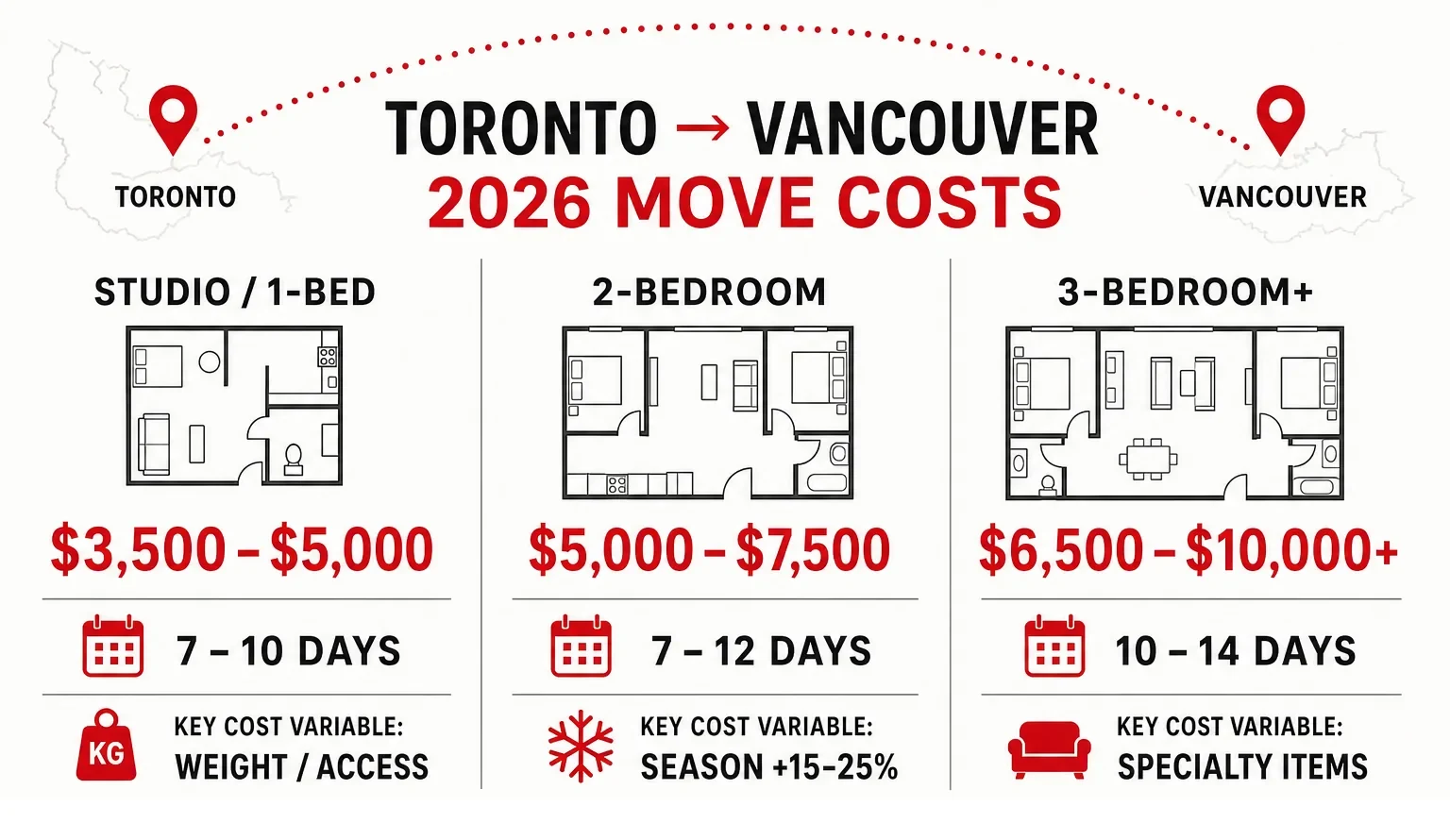
Here’s what we’re quoting in 2026 based on Motion Transport’s internal data and industry averages:
| Move Size | Estimated Cost | Transit Time | Key Cost Variables |
|---|---|---|---|
| Studio / 1-bedroom | $3,500–$5,000 | 7–10 business days | Weight, floor/elevator access, packing services |
| 2-bedroom | $5,000–$7,500 | 7–12 business days | Season (summer adds 15–25%), bulky items |
| 3-bedroom+ | $6,500–$10,000+ | 10–14 business days | Specialty items (piano, hot tub), door-to-door vs depot |
Looking to bring the cost down? Two levers move the number more than anything else:
- Ruthless decluttering: Long-haul pricing is driven by weight. Every 500 lbs you shed saves roughly $300–$500. Sell the IKEA furniture. Buy new on the other side.
- Moving off-peak: Summer is the most expensive window of the year — peak season adds 15–25% to the same shipment. If your dates are flexible, shifting into the shoulder season is the easiest saving you’ll find.
For a deeper breakdown of interprovincial pricing, check out what is average cost of moving to another province.
Binding vs Non-Binding Estimates: Read This Before You Sign Anything
This is the single most common source of moving disputes in Canada, and almost nobody explains it upfront. We do.
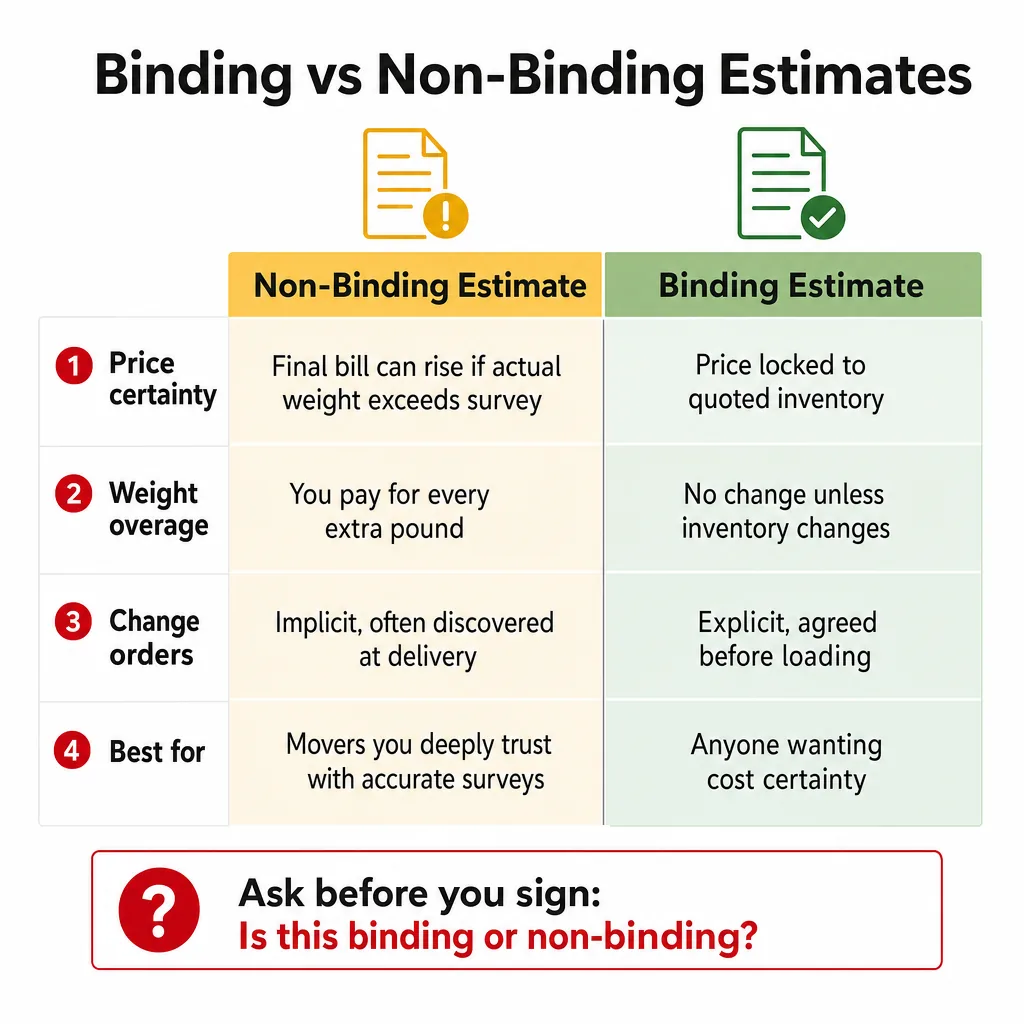
A non-binding estimate is a best guess. The mover surveys your goods, gives you a number, and then weighs the actual shipment. If your stuff weighs more than estimated, your final bill goes up — sometimes significantly. Non-binding estimates are common and not inherently dishonest, but they require trust in the mover’s initial survey accuracy.
A binding estimate locks the price. You pay what was quoted, provided the inventory doesn’t change. If you add your grandmother’s armoire after the survey, that’s a change order. But your core price is protected.
What to ask any mover before booking:
- Is this estimate binding or non-binding?
- If non-binding, what happens if the actual weight exceeds the estimate by 10%? By 20%?
- Is packing included, or is that a separate line item?
- Are fuel surcharges, stairs, or elevator fees baked in, or added later?
At Motion Transport, we provide written estimates that itemize every variable. We quote what it costs and move what we quoted. If something changes, we tell you before the truck is loaded — not after it arrives in Vancouver.
Delivery Windows: Long-Haul Is a Range, Not a Date
This catches people off guard more than almost anything else. When you book a long-haul move, you receive a delivery window — typically 7 to 14 business days from pickup — not a guaranteed date. That’s standard industry practice across Canada, and it exists for legitimate reasons: weather, road conditions, consolidated loads, and the reality that 4,400 km is a long way for anything to go perfectly on schedule.
What that means practically: do not schedule your first week of work, your lease start date, or your kids’ school enrollment around a specific delivery day. Plan for the outer edge of the window.
Before you book, ask:
- What is the estimated delivery window for my move dates?
- Will I receive updates when the truck departs Toronto and when it crosses into BC?
- Who do I call if the window passes without delivery?
We send our customers regular status updates and give them a direct contact number — not a queue. If something shifts, you hear it from us before you’re left wondering.
Valuation Coverage: What Actually Protects Your Belongings
The draft you may have read elsewhere covers car shipping insurance in detail. What it skips is the coverage that applies to your household goods — which is the part most people actually care about.
Carrier liability is not insurance. Under standard Canadian moving tariffs, movers carry a baseline liability of $0.60 per pound per article. That means a 40 lb flat-screen television worth $1,200 is covered for $24 if it’s damaged. That number is not a typo.
Released value coverage is what most movers include by default: it costs you nothing and protects you for almost nothing.
Full value protection (sometimes called declared value coverage) means the mover is liable for repair, replacement, or a cash settlement at current market value. This costs more — typically calculated as a percentage of your declared shipment value — but it’s the only coverage that actually makes you whole if something breaks.
Your home or tenant insurance policy may extend to goods in transit. Call your broker before your move date and ask directly. Some policies cover it; many exclude it or cap it at a level that doesn’t reflect the full value of a household.
What to ask any mover:
- What is your default liability per pound?
- Do you offer full value protection, and what does it cost for my shipment?
- What is your claims process, and what is the typical resolution timeline?
Storage in Transit: When Your Closing Dates Don’t Line Up
Closing dates are rarely perfectly synchronized. You may hand over your Toronto keys on the 28th and not get into your Vancouver place until the 5th. That gap is common, and it has a name: storage in transit (SIT).
Most long-haul movers, including us, can hold your shipment at a secure warehouse facility at the destination end while you wait for possession. It’s not free — expect daily or weekly storage rates that vary by shipment volume — but it’s far simpler than scrambling for a last-minute solution after your goods are already in a truck 4,000 km from home.
Ask about SIT before you book:
- Do you offer storage in transit at the Vancouver end?
- What is the daily or weekly rate, and is there a minimum?
- Is the storage facility climate-controlled and secured?
- How quickly can you deliver from storage once I have access to my new place?
Plan for the possibility even if you think your dates will line up. They often don’t.
Access Conditions and Surcharges: Where Hidden Fees Hide
The quote looked great. Then the invoice arrived with three extra line items. Here’s what causes that.
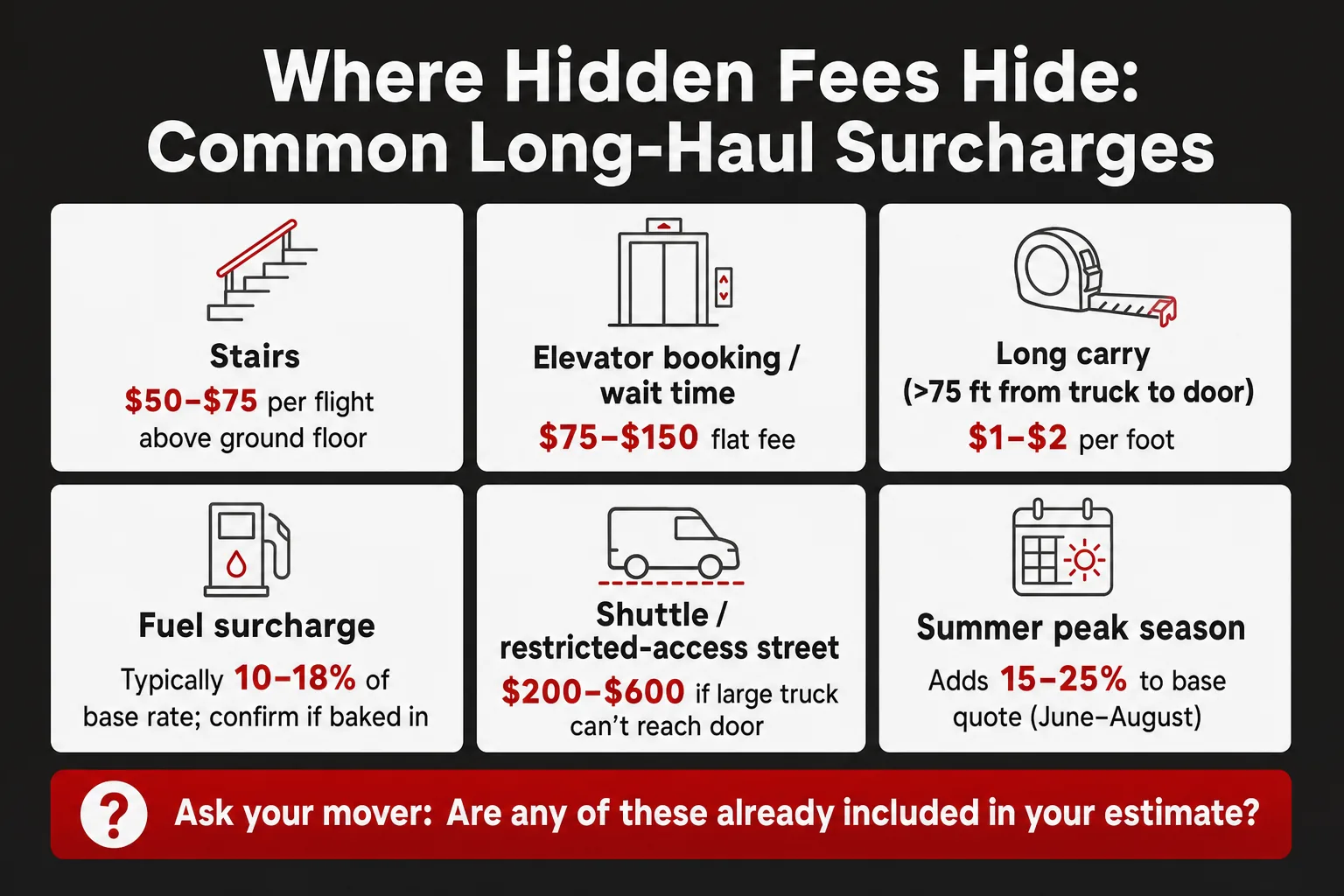
Stairs: Most movers charge a per-flight fee for carries beyond the ground floor when no elevator is available. If you’re moving out of a Toronto walk-up or into a Vancouver unit with a broken elevator, that’s a real cost.
Long carry: If the truck cannot park within a standard distance of your door — typically 75 feet — the extra carry time is billed as a surcharge.
Shuttle service: Narrow streets, low-clearance parkades, and residential lanes that can’t accommodate a full semi are common in both cities. When the big truck can’t get close, a smaller shuttle vehicle transfers your goods the last stretch. Shuttle fees can add $300–$600 depending on volume and distance.
Elevator reservations: In a condo building, you’re often required to book the service elevator. Failing to book it — or having the booking fall through — can stall your move for hours. Confirm with your building manager before move day.
What to do: When you request a quote, tell us exactly what your origin and destination look like. Street type, building floor, elevator access or lack thereof, parking restrictions. We build those variables into the estimate. Surprises on move day should be surprises, not fees we could have told you about in week one.
What Actually Happens on Move Day — and at Delivery
At origin (Toronto):
The crew arrives, does a walk-through with you, and inventories every item being loaded. Each piece gets a numbered sticker; those numbers appear on a condition report. You sign the bill of lading, which is the legal contract for your shipment. Review it before you sign. If something is already damaged, note it.

The truck is loaded and sealed. You receive a copy of the inventory and the bill of lading. Keep both.
In transit:
Your shipment travels 4,400 km. Depending on load consolidation, it may share the truck with other customers’ goods moving west. That’s normal and doesn’t affect how your items are handled.
At destination (Vancouver):
The crew arrives within your delivery window, unseals the truck, and delivers to room of choice. You cross-reference every item against the inventory list as it comes off the truck. Note any damage on the delivery receipt before you sign it. Once you sign without notation, claiming damage afterward becomes significantly harder.
If something is missing or damaged, do not accept the shipment without noting it in writing. Tell the crew, note it on the delivery receipt, and photograph everything.
Deposits, Payment Terms, and How to File a Claim
Deposits: Most long-haul movers require a deposit at booking, typically 10–25% of the estimated cost. This is standard. Be cautious of any mover requesting full payment upfront before the truck is loaded.
Final payment: Generally due at delivery, before the truck is unloaded. Accepted methods vary — confirm in advance whether the mover accepts credit card, certified cheque, or e-transfer. Some carriers are cash-only at delivery, which can be inconvenient if you’re not prepared.
Filing a claim: If items are damaged or missing, file in writing as soon as possible. Most movers have a formal claim form. Under standard tariff rules, movers must acknowledge a claim within a set number of days and resolve it within a reasonable period. Keep your inventory list, bill of lading, condition report, and photographs. Those documents are your evidence.
If a mover refuses to acknowledge a claim or ghosts you, the Canadian Association of Movers (CAM) maintains a dispute resolution process for members.
How to Vet a Long-Haul Mover Before You Book
Not every company with a website and a phone number is a legitimate carrier. Here’s the short list of what to check.
CAM membership: The Canadian Association of Movers maintains a member directory. Membership requires adherence to a code of ethics and provides a dispute resolution path. It’s not a guarantee, but it’s a meaningful signal.
NSC (National Safety Code) number: Canadian commercial carriers operating interprovincially are required to have an NSC number. Ask for it. You can verify it through the relevant provincial transport authority. If a mover can’t provide one, walk away.
Written estimate: Any reputable mover will put the estimate in writing and specify whether it is binding or non-binding. Verbal quotes are not contracts.
References: Ask for two or three recent customer references from moves of similar size and distance. A company that can’t produce references for a $6,000–$10,000 job is telling you something.
Online reviews: Read them, but weight recent reviews more heavily than older ones. Look specifically for comments about final billing versus quoted price, communication during transit, and how the company handled problems.
Gut check: Call them. Does a real person answer? Can they answer specific questions about delivery windows, valuation coverage, and access surcharges? A company that gets vague when you ask direct questions about pricing will be vague when something goes wrong.
Cost to Ship a Car from Toronto to Vancouver (2026)
A car sitting in your Toronto driveway doesn’t magically appear in Vancouver. You’re either driving it 4,400 km or paying someone to move it.
| Shipping Method | Price Range | Transit Time | Insurance |
|---|---|---|---|
| Open carrier | $1,200–$1,800 | 7–12 days | Basic carrier liability included |
| Enclosed carrier | $1,800–$2,800 | 8–14 days | Enhanced coverage, typically $50K+ |
| Rail (CN/CP Auto) | $1,000–$1,500 | 10–18 days | Carrier liability; supplemental available |
Known carriers in Canada include ShipMyRide, Trudel, MVS Canada, and A-1 Auto Transport. I’m not endorsing any of them — get three quotes minimum and verify their Canadian carrier licensing and bill of lading terms.
What drives the price up: Vehicle size and weight, summer peak season (add 10–20%), and door-to-door delivery versus terminal-to-terminal pickup.
Before shipping: Drain fuel to a quarter tank, remove all personal items (they’re not insured), and photograph every scratch and ding. Document everything. You’ll thank yourself later.
One note: VIA Rail discontinued its auto-on-train service years ago. I still get asked about it monthly. It doesn’t exist anymore.
How Much Does It Cost to Ship a Car Across Canada?
| Distance | Price Range |
|---|---|
| Under 1,000 km | $500–$900 |
| 1,000–3,000 km | $900–$1,500 |
| 3,000–4,500 km | $1,200–$1,800+ |
Toronto to Vancouver is ~4,400 km — the top end of that range. The alternative is driving it yourself: budget $800–$1,200 in fuel, plus 4–5 nights of lodging at $120–$180/night. Total: roughly $1,500–$2,500, plus the wear on your car and your patience.
If you’re evaluating full-service options that bundle household goods and vehicle transport, check out our province to province moving services.
Life on the Other End: A Brief Orientation
Once the truck is unloaded, here’s the context that matters for your first weeks in BC.
Cost of living: Vancouver runs about 5–8% higher than Toronto on rent and marginally more on groceries, though utilities are actually cheaper — mild winters mean lower heating bills. Monthly transit is $110–$177 depending on TransLink zone, versus Toronto’s flat $156 TTC pass. On balance, the cities are remarkably close.
| Category | Toronto | Vancouver | Source |
|---|---|---|---|
| 1-bed rent (outside centre) | $1,850 | $1,950 | Numbeo, June 2026 |
| Monthly grocery basket (single) | $380 | $395 | Numbeo, June 2026 |
| Monthly transit pass | $156 | $110–$177 (zone-dependent) | TTC / TransLink |
| Basic utilities (85 m² apartment) | $185 | $145 | Numbeo, June 2026 |
Provincial tax: BC’s rates are slightly friendlier at middle incomes than Ontario’s, though they converge above $150K. The practical difference at $80,000 gross is roughly $240 per year in BC’s favour.
MSP enrollment: BC’s Medical Services Plan covers you starting the first day of the third month after you establish residency. Apply within your first three months using the HLTH 102 form at gov.bc.ca. Buy interim private health insurance for the wait period — a basic plan runs $80–$150/month. Do not cancel your OHIP card until MSP is active.
Job market: Vancouver’s unemployment rate has been running about a full point below Toronto’s through 2026 (5.8% vs 7.1%, per Statistics Canada’s April 2026 Labour Force Survey). Tech and professional services are strong in both cities.
For a broader checklist covering driver’s licence transfers, address changes, and other provincial admin, read our moving to another province in canada guide.
Ready to Move? Get a Transparent Quote from Motion Transport
The physical move is the one part of this relocation you don’t have to figure out on your own.
- Budget $3,500–$10,000+ for household goods depending on move size and service level
- Ask about binding estimates, valuation coverage, and delivery windows before you commit to any mover
- Get car shipping quotes early — summer bookings fill fast and prices jump 10–20%
- Confirm your access conditions so there are no surcharge surprises on move day
Call us directly — you’ll reach a real person, not a call centre — or fill out our online form and we’ll respond within one business day with transparent, all-in pricing. Explore our province to province moving services, or read how to prepare for a long distance move across provinces for a full prep checklist.
For more on planning a cross-country relocation, read the ultimate guide for moving long distance in canada.
Data References
- Numbeo Cost of Living Index — Toronto and Vancouver, June 2026 data
- TRREB (Toronto Regional Real Estate Board) — Market Watch, Q1 2026
- REBGV (Greater Vancouver Realtors) — Monthly Statistics, Q1 2026
- Statistics Canada — Labour Force Survey, April 2026 release
- Government of British Columbia — Personal income tax rates 2026 (gov.bc.ca)
- Ontario Ministry of Finance — 2026 provincial tax brackets
- Government of British Columbia — MSP enrollment (gov.bc.ca)