
Charles and his team have spent enough time at border crossings to know that the difference between a smooth move and a three-day customs hold usually comes down to one missing form. As Director of Operations at Motion Transport, Charles and his team are the reason your furniture arrives before your patience runs out.
Why the Border Is the Part Most Moving Companies Gloss Over
Every cross border moving company’s website will tell you they offer packing, loading, and delivery. Very few explain what happens between the loading dock in Toronto and the front door in Austin.
That gap isn’t accidental. The border crossing is the hardest part of a Canada-to-US move, and most companies would rather not draw attention to something they’re only half-equipped to handle. I’ve watched DIY movers and under-qualified outfits get stuck at the same chokepoints for years — mismatched inventory lists, missing customs forms, a bottle of homemade wine that nobody thought to declare.
Here’s the scale of what we’re talking about: U.S. Customs and Border Protection processes over 11 million import entries every year, according to CBP.gov. Your household goods don’t get a special lane. They follow the same formal entry process as commercial freight. Same forms. Same scrutiny. Same consequences if something’s wrong.
This article walks through what a legitimate Canada-to-US moving company actually handles at the border — step by step — so you know what you’re paying for and what to ask before you sign anything.
CBP Form 3299 and Duty-Free Entry: The Paperwork Your Mover Files for You
CBP Form 3299 — officially called the “Declaration of Free Entry of Unaccompanied Articles” — is the document that tells U.S. Customs your household goods are personal belongings, not commercial imports. Without it, your sofa gets treated like a shipment of sofas headed to a furniture store.
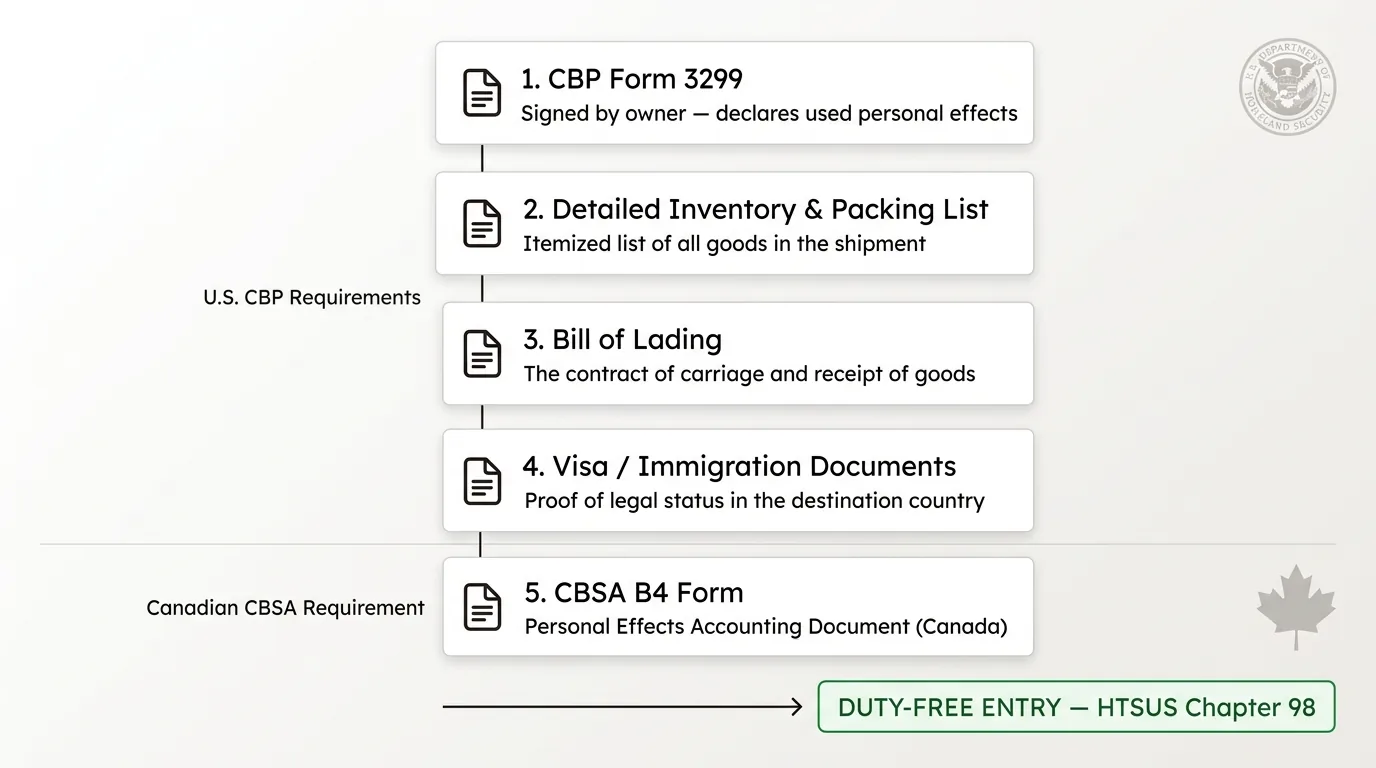
Your mover files this form on your behalf. It declares that the items in your shipment are used personal effects and household goods that you’ve owned and used for at least one year before importing them. That one-year-of-use rule is what qualifies your belongings for duty-free entry under HTSUS Chapter 98 — meaning you don’t pay import duties on your own stuff, provided the paperwork is done correctly. The CBP help page at help.cbp.gov spells this out clearly, and I’d recommend reading it once even if your mover handles everything.
A qualified cross-border mover prepares the following documents before your shipment reaches the port of entry:
- CBP Form 3299 — completed and signed by the owner
- Detailed inventory and packing list — every box numbered, every item described
- Bill of lading — the shipping contract between you and the carrier
- Copy of your visa or immigration documents — proving your legal right to enter the US
- Proof of prior residence — utility bills, lease, or mortgage statement from your Canadian address
There’s a Canadian side to this too. CBSA requires notification when personal effects leave the country. If your goods are “following the owner” — meaning they ship after you’ve already crossed — you’ll need the CBSA B4 form (Personal Effects Accounting Document) on file. A mover who only knows the American side of the paperwork is a mover who’s done this twice.
One more thing: restricted and prohibited items. Alcohol has quantity limits. Firearms require separate ATF permits. Certain food products — fresh produce, dairy, meat — can’t cross at all. A competent mover flags every one of these before loading day, not at the border when a CBP officer is holding up the line.
What It Actually Costs to Move from Canada to the US in 2026
The most common question I get isn’t about paperwork. It’s about money. Here are realistic 2026 cost ranges for a Canada-to-US move with a licensed cross-border mover:
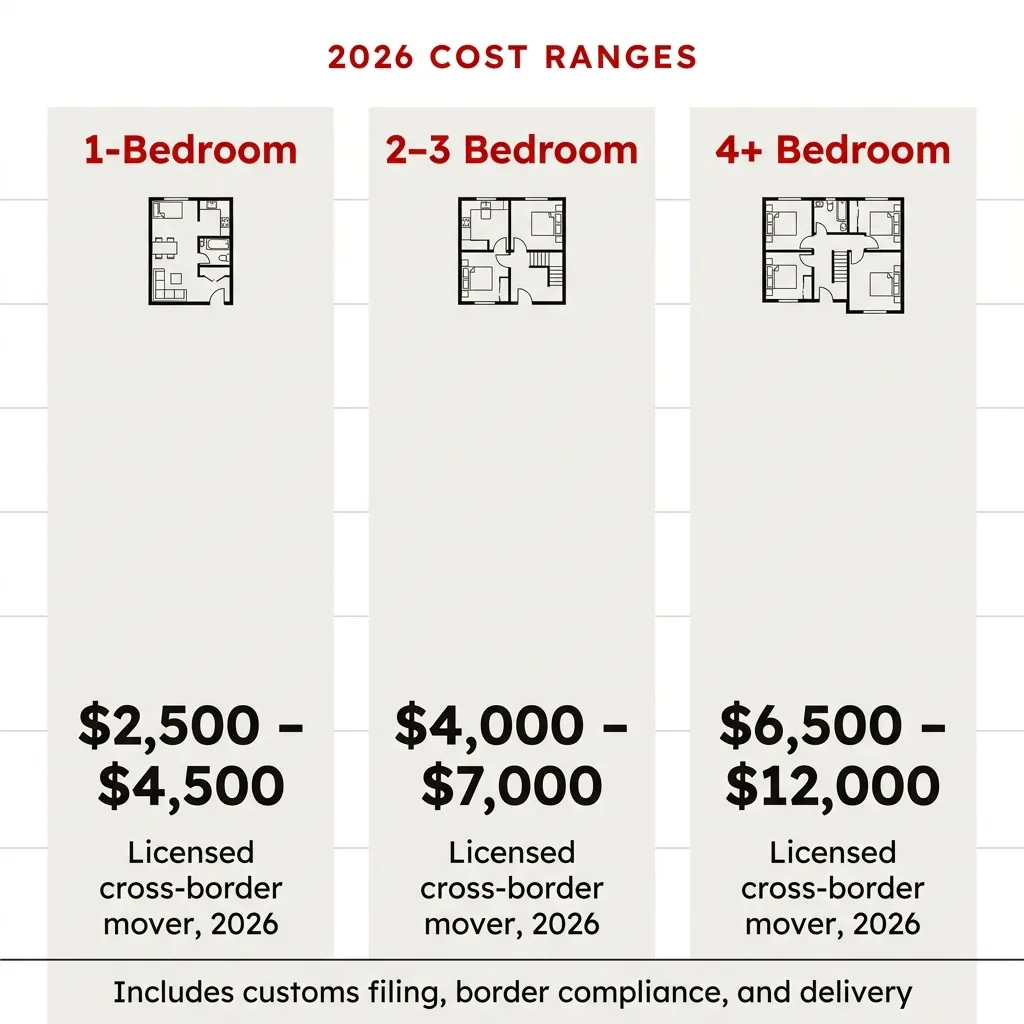
- 1-bedroom apartment: ~$2,500–$4,500 CAD
- 2-bedroom home: ~$4,000–$7,000 CAD
- 3-bedroom house: ~$6,500–$12,000+ CAD
Distance, access (stairs, elevators, long carries), and customs brokerage fees all push the final number around. A move from Vancouver to Seattle costs less than a move from Halifax to Miami — that shouldn’t surprise anyone, but the quotes some people get certainly do.
A legitimate quote includes packing labour, materials, transport, customs brokerage, basic insurance, and delivery. A budget quote leaves out half of that and tacks it on later. If a quote doesn’t explicitly mention customs brokerage, ask where that cost shows up — because it will show up.
The “cheapest way to move from Canada to the US” search leads a lot of people toward renting a U-Haul. Here’s the problem: many U-Haul locations won’t allow a one-way rental from Canada to the US at all. Even where they do, the customer handles every piece of customs paperwork and border clearance themselves. No customs broker. No pre-filed forms. Just you, a 26-foot truck, and a CBP officer who’s seen this go badly before.
For context, if you’re comparing these numbers to domestic moves, check out what is average cost of moving to another province — the cross-border premium exists, but it buys you customs clearance, not just kilometres.
A binding or not-to-exceed quote from a licensed mover protects you from surprise charges. Hourly or weight-based estimates that balloon at the border are a pain in the ass to dispute after the fact. We quote what it costs and move what we quoted. That’s the policy.
Insurance and Liability: Full Value Protection vs. Released Value
A cross-border move puts your belongings through more handling points than a domestic one — loading, border inspection, possible temporary holds, unloading. More touchpoints mean more risk.
Released value protection is the default, no-additional-cost option that FMCSA requires every mover to offer. It covers $0.60 per pound per article. Your 50-pound flat-screen TV? That’s $30 of coverage. The FMCSA liability and protection page on fmcsa.dot.gov explains this clearly, and I’d encourage every person getting a quote to read it.
Full value protection (FVP) makes the mover liable for the replacement value of any lost or damaged item. It costs more — typically a percentage of the declared shipment value — but it provides actual financial protection.
For high-value items like art, electronics, or musical instruments, third-party transit insurance is worth considering on top of FVP. These policies cover scenarios that standard mover liability sometimes excludes.
Before you sign with any Canada-to-US moving company, ask for a written explanation of both options. If a company can’t clearly explain the difference, that tells you something about how they handle the rest of the process. For more on supplementary coverage and additional services by your long distance moving company, we’ve put together a separate guide.
Bringing Pets Across the Border: 2026 CDC and USDA Rules
The CDC’s updated dog import requirements — effective since August 2024 and still in force in 2026 — catch people off guard more than almost anything else in a cross-border move.
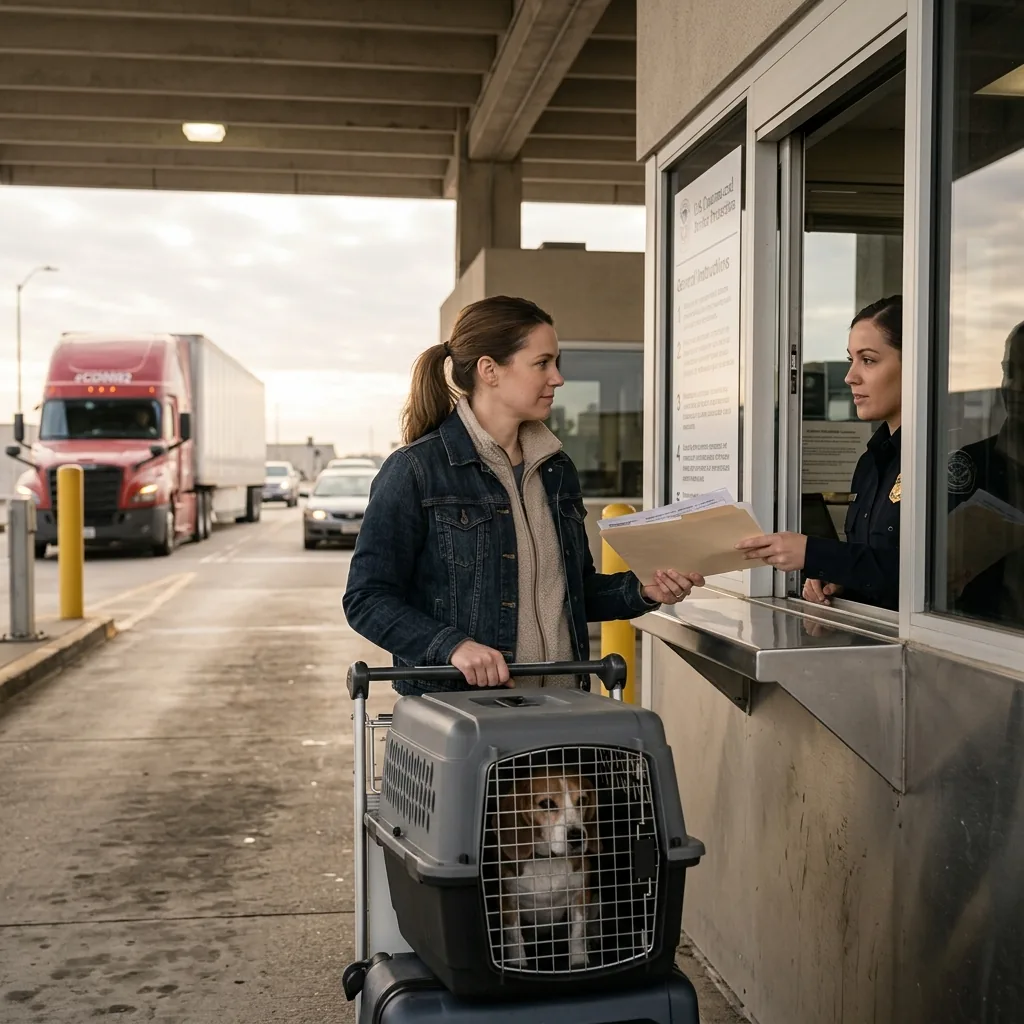
All dogs entering the United States must be:
- At least 6 months old
- Microchipped with an ISO-compatible 15-digit chip
- Accompanied by a completed CDC Dog Import Form (submitted online before arrival)
Canada is classified as a dog rabies-free or low-risk country, so dogs coming from Canada have a simplified pathway. But “simplified” still means the online form and microchip verification are mandatory. Skip either one and your dog can be denied entry or quarantined. The CDC’s dog import page at cdc.gov lays out the full requirements.
Cats currently have no federal vaccination requirement for US entry, but individual states impose their own rules. The USDA APHIS pet travel page covers cats and other animals — check the requirements for your destination state specifically.
What can a cross-border moving company do here? We coordinate timing so your pet’s paperwork aligns with the shipment’s border crossing date. But the pet owner must obtain the veterinary documents. Start this process at least 4–6 weeks before your move date. I’ve seen families scramble for vet appointments the week before departure, and it never ends well.
The Complete Canada-to-US Moving Checklist (2026)
A cross-border move has more moving parts than a domestic one. This timeline keeps things from falling through the cracks.
8 Weeks Before Moving Day
- Confirm your visa or immigration status — nothing else matters if this isn’t settled
- Get quotes from licensed cross-border movers (ask about customs brokerage specifically)
- Start pet paperwork: vet appointments, microchipping, CDC Dog Import Form if applicable
- Begin a detailed inventory of everything you plan to bring
4 Weeks Before Moving Day
- Finalize your inventory and flag prohibited items (alcohol, firearms, restricted food)
- Notify CBSA of your departure and file the B4 form for goods following the owner
- Arrange mail forwarding through Canada Post
- Cancel or transfer Canadian utilities, subscriptions, and memberships
2 Weeks Before Moving Day
- Confirm packing dates with your mover
- Review insurance options — choose between full value protection and released value
- Gather personal documents: passport, visa, SIN card, SSN application paperwork
- Set aside a personal essentials bag (medications, chargers, documents, a change of clothes)
Moving Week
- Supervise loading — verify box counts against the inventory list
- Confirm all customs brokerage documents are complete and signed
- Keep your essentials bag with you, not on the truck
After Arrival
- Be present for delivery and check every item against the inventory
- File a change of address with USPS
- Register for a state ID or driver’s licence in your new state
If your arrival date doesn’t line up with delivery — common when customs adds a day or two — we offer storage solutions to bridge the gap.
Frequently Asked Questions About Moving from Canada to the US
How much does it cost for a Canadian to move to the US?
Expect $2,500–$4,500 CAD for a 1-bedroom, $4,000–$7,000 CAD for a 2-bedroom, and $6,500–$12,000+ CAD for a 3-bedroom house in 2026. Final cost depends on distance, shipment volume, access conditions, and whether customs brokerage is included in the quote. Always ask for a binding or not-to-exceed estimate.
What is the best way to move from Canada to the US?
Hire a licensed cross-border moving company that handles customs brokerage in-house. DIY options like U-Haul have strict cross-border limitations — many locations won’t even allow a one-way Canada-to-US rental — and all customs paperwork falls on you. For guidance on vetting movers, read our guide on how to find a reliable long distance moving company in canada.
How do I move my stuff from Canada to the USA?
A professional cross-border mover loads your belongings, transports them to the border, files CBP Form 3299 for duty-free entry, clears customs, and delivers to your US address. You focus on immigration paperwork and settling in. The mover handles the logistics; you handle the life stuff.
Are Canadians moving to the US in 2026?
Yes. Cross-border moving demand has stayed steady through 2026, driven by job relocations, family reunification, and lifestyle changes. The process is straightforward with proper planning and a qualified mover — the people who run into trouble are almost always the ones who started too late or skipped the paperwork.
Make the Border the Boring Part
The single most important thing to understand about a Canada-to-US move: the border crossing is either the hardest part of your move or the most uneventful, depending entirely on who’s handling the paperwork.
- Get quotes from licensed cross-border movers who include customs brokerage in writing
- Start pet and immigration paperwork at least 8 weeks before your move date
- Choose full value protection over released value — $0.60 per pound isn’t coverage, it’s a formality
If you’re planning a move from Canada to the US in 2026, I’d rather you call us with questions now than call us in a panic from a customs holding area later. Get a free cross-border moving quote from Motion Transport — we’ll tell you exactly what it costs, what we handle at the border, and what you need to have ready.