
Charles and his team have personally shepherded enough couches across the Canada-US border to know which CBP forms give people nightmares — and exactly how to fill them out so nobody loses sleep.
A Cross-Border Move Isn’t Just a Longer Drive
A domestic mover loads your stuff, drives it somewhere, and unloads it. A cross border moving company does all of that plus navigates customs declarations, duty assessments, tax obligations, and regulatory filings that your average long-haul crew has never heard of — let alone completed.
Here’s a partial list of the extra layers sitting between your Canadian front door and your American one:
- CBP paperwork — specifically Form 3299, filed for every household goods shipment entering the US
- 72-hour advance filing via the Automated Commercial Environment (ACE) system, required before the truck reaches the border
- Customs brokerage — either handled in-house or subcontracted to a licensed broker
- Vehicle import compliance — EPA emissions forms, DOT safety declarations, and applicable tariffs
- Pet import rules — rabies documentation and the updated CDC dog import rule still enforced in 2026
- CRA departure tax considerations — deemed disposition of assets when you cease Canadian residency
That’s a lot of acronyms. I’ll walk through each layer so you know exactly what you’re paying for — and why a regular mover quoting you a suspiciously low number probably can’t deliver on half of it. U.S. Customs and Border Protection publishes the foundational rules for importing personal effects at CBP.gov, and the USDA’s APHIS division handles animal and plant import regulations.
Customs Paperwork a Cross-Border Mover Handles for You
Most people have no idea that CBP Form 3299 — the Declaration of Free Entry of Unaccompanied Articles — even exists until about two weeks before their move. It’s the document that lets your household goods and personal effects enter the United States duty-free, provided you owned and used them before the move. Skip it or fill it out wrong, and your shipment sits in a customs warehouse while you sit in an empty living room.

A licensed cross-border mover prepares this form using your detailed inventory list. They match every item against CBP’s restricted and prohibited items list before loading day. That pre-audit matters. I’ve watched shipments get held at the border because someone packed a can of bear spray or a restricted food product they forgot about. A ten-minute review in your living room prevents a multi-day delay at the port of entry.
The 72-Hour Advance Filing Requirement
The carrier hauling your belongings must transmit electronic manifest data through the ACE system at least 72 hours before arriving at the US border. This isn’t optional — it’s a CBP mandate. The moving company’s dispatch team handles the filing, which includes shipment details, carrier information, and the goods description. If the data isn’t transmitted on time, the truck doesn’t cross. Period.
Customs Brokerage: What It Costs and Who Does It
A customs broker is the licensed professional who formally clears your goods through US Customs. Some moving companies employ brokers on staff. Others subcontract the work. Either way, you’re paying for it.
In 2026, customs brokerage fees for a standard household goods shipment typically run $150 to $500+, depending on shipment complexity. A straightforward apartment move with a clean inventory sits at the lower end. A four-bedroom house with a vehicle, antique furniture requiring appraisal, and items that need tariff classification pushes toward the higher end.
The distinction matters: the mover packs, loads, and transports. The broker files the entry, pays any applicable duties on your behalf, and gets your goods released. When both functions live under one roof, coordination is tighter and fewer things fall through the cracks.
How Much Does It Cost to Move From Canada to the US in 2026?
A typical 2–3 bedroom household move from Canada to the US costs between $3,000 and $9,000+ in 2026. That range is wide because cross-border moves have more variables than domestic ones.
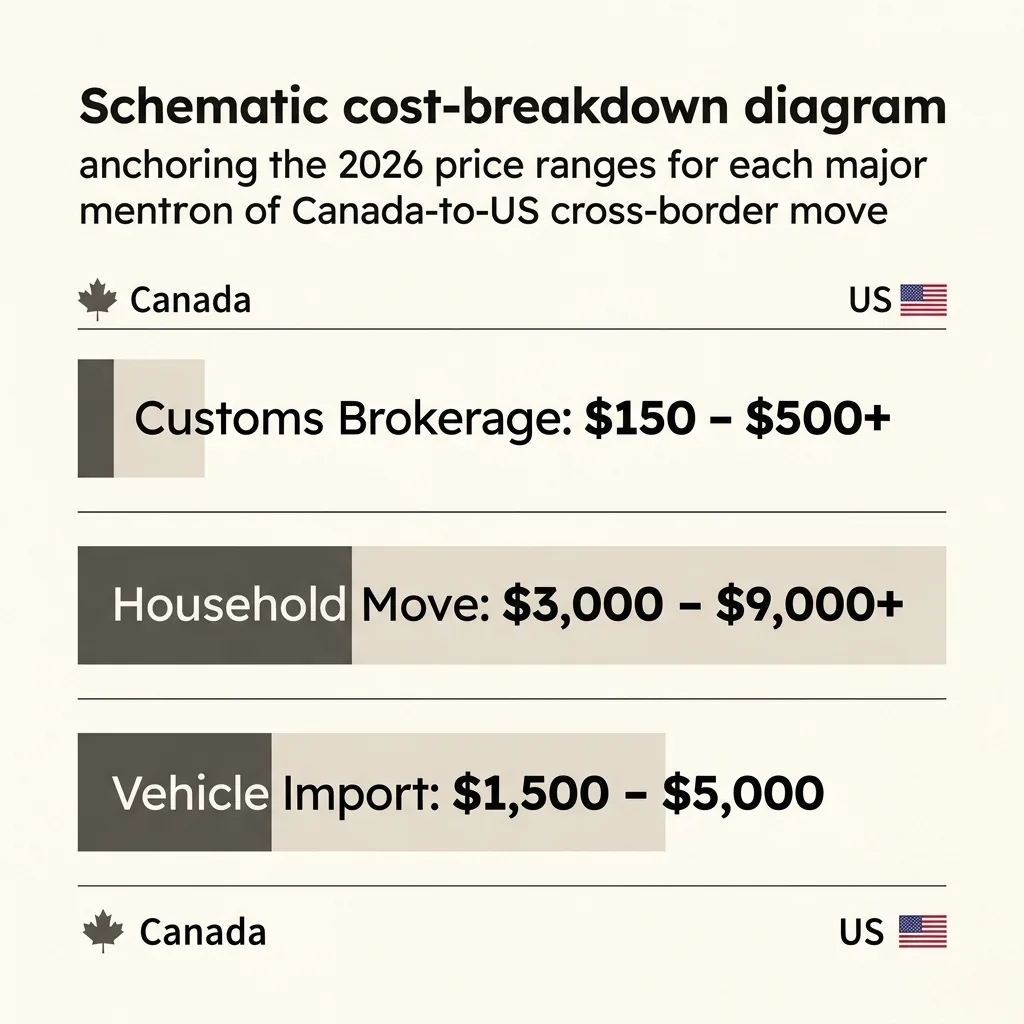
Here’s how the costs break down by line item:
| Cost Component | Typical Range (2026) |
|---|---|
| Packing and loading labour | $500 – $1,500 |
| Transport (distance + weight) | $1,500 – $5,000+ |
| Customs brokerage | $150 – $500+ |
| Transit insurance | $200 – $600 |
| Storage (if needed) | $100 – $400/month |
| Duties/tariffs on non-personal items | Varies |
What drives quotes apart: the distance between origin and destination cities, total shipment weight, time of year (summer moves cost more — every year, without fail), and whether you need full-service packing or just transport.
The cheapest option isn’t always a bargain. Unlicensed movers may not carry the required US DOT authority or a customs bond. If your goods get flagged at the border and your mover can’t produce the right credentials, you’re the one paying storage fees while everything sorts itself out.
The cheapest moving company is the one that doesn’t surprise you with hidden fees or border delays. Ask for an itemized quote. If a company can’t break down what you’re paying for, that’s your answer. For a domestic cost comparison, check out what is average cost of moving to another province — then you’ll see exactly where cross-border premiums come from.
Importing Your Vehicle: Duty, EPA, and DOT Compliance
A passenger vehicle imported from Canada into the US is subject to a 2.5% tariff under HTS code 8703 (verify the current rate at time of your move — 2026 trade policy has been a moving target, pun intended). That’s 2.5% of the vehicle’s declared value, paid at the border.

Beyond the tariff, your vehicle must meet US emissions and safety standards. Canadian-spec vehicles generally comply, but generally isn’t a word that impresses a customs officer. You’ll need to file:
- EPA Form 3520-1 — declaring the vehicle meets Clean Air Act standards
- DOT Form HS-7 — declaring compliance with Federal Motor Vehicle Safety Standards
A cross-border moving company coordinates with a customs broker to file vehicle paperwork alongside your household goods shipment. That means one import process, one broker, one point of contact — instead of you managing two separate entries and praying the timelines align.
If you’re importing a vehicle that’s been modified (lifted trucks, aftermarket emissions equipment), expect additional scrutiny. Flag it early. Surprises at the border are never the fun kind.
Pets, Plants, and the Stuff a Regular Mover Won’t Touch
The CDC’s updated dog import rule — effective August 2024 and still fully enforced in 2026 — requires dogs entering the US to have current rabies vaccination documentation regardless of country of origin. Dogs from Canada must arrive with a valid rabies certificate and meet the CDC’s appearance-of-good-health standard. Cats face fewer restrictions but still need rabies documentation for most states.
The USDA’s Animal and Plant Health Inspection Service (APHIS) publishes the current requirements at aphis.usda.gov. Check before you book your move, because the rules have tightened over the past two years.
Plants, firewood, and certain food items are restricted or outright prohibited. A cross-border mover flags these during the pre-move survey — the walkthrough where they inventory your belongings and identify anything that could cause a problem at the border. A standard domestic mover has zero process for any of this. They’ve never had to think about whether your potted ficus is going to trigger an agricultural inspection.
Tax Obligations on Both Sides of the Border
This is the part that catches people off guard because it has nothing to do with moving trucks and everything to do with money. When you cease to be a Canadian resident, the CRA treats you as if you’ve sold certain property — investments, rental properties, some personal assets — at fair market value on the day you leave. This is called deemed disposition, and it can trigger a capital gains tax bill that arrives months after you’ve settled into your new American life.
The CRA publishes guidance on departure tax obligations on canada.ca. Read it, or better yet, hire a cross-border tax specialist before moving day. Not after. Before.
On the US side, new residents must report worldwide income on IRS Form 1040. The Canada-US tax treaty exists to prevent double taxation, but it doesn’t apply automatically — you need to claim treaty benefits correctly on your return. The IRS publishes filing requirements for US residents with foreign income on irs.gov.
A moving company doesn’t do your taxes. I want to be clear about that because I’ve seen competitors imply otherwise. What a good cross-border mover does is remind you that these obligations exist, refer you to qualified cross-border tax professionals, and help you time your move to avoid unnecessary complications. If you need to delay your physical move while sorting out residency timing, we offer storage solutions to bridge the gap.
I tell you this stuff not because it’s fun to talk about taxes. I tell you because I’ve watched clients get a five-figure CRA bill six months after their move and wish someone had mentioned it earlier.
FAQ: Common Questions About Moving From Canada to the US
How do I move my stuff from Canada to the USA?
Step by step: get quotes from licensed cross-border movers (confirm they hold US DOT and FMCSA authority). Schedule a pre-move survey so the company can inventory your belongings. Prepare your customs documents — your mover handles CBP Form 3299 and the 72-hour ACE filing. On moving day, the crew packs and loads. The shipment clears customs at the border, and delivery happens at your US address. The whole process typically takes 5–14 days depending on distance.
What is the easiest way for a Canadian to move to the USA?
Hire a full-service cross-border moving company that handles customs brokerage, packing, transport, and delivery under one operation. DIY moves are possible, but you’ll need to file your own CBP paperwork, clear customs personally, and rent a vehicle with proper cross-border insurance. Most people who try the DIY route once don’t try it twice.
How much does it cost to move from Canada to the US?
A 2–3 bedroom household typically costs $3,000–$9,000+ in 2026. See the detailed cost breakdown above for line-item pricing.
What is the cheapest moving company to use?
Forget cheapest. Look for transparent. A mover that includes customs brokerage in their quote, carries proper US DOT authority, and itemizes every fee will almost always cost you less than the “cheap” option that hits you with border delays and surprise charges. Check out our full range of moving services to see what’s included.
Ready to Cross the Border Without the Headaches?
A Canada-to-US moving company earns its fee by handling customs, compliance, and coordination that a domestic mover simply can’t.
- Verify licensing: your mover needs US DOT authority and a customs bond — ask for the numbers
- Get an itemized quote: if they can’t break down customs brokerage, transport, and insurance as separate line items, walk away
- Talk to a cross-border tax specialist before your move date — not after the CRA sends you a letter
We quote what it costs. We move what we quoted. If you want a transparent cross-border moving quote from real people who actually answer the phone, reach out to Motion Transport. And if you’re still in the research phase, here’s a solid starting point: how to find a reliable long distance moving company in canada.